In the homewear catalogue compared, black and white took about 40% of estimated demand for women's loungewear from 3 September to 29 October 2026, but that lead belongs almost entirely to base layers. Bodysuits, camis and undershirts were about three-quarters black and white. On trousers the pair was 17.7%, and no colour clearly led. Base layers and trousers each took about a third of estimated demand. About half of it was under EGP 500. In late October, about 89% of S sizes were available against about 65% of 3XL.
All figures are estimated demand, not reported sales, in one homewear catalogue, 3 September to 29 October 2026. They are not the whole market and not a yearly pattern. Advice is Mojo's judgment. For fit and fabric across all homewear, start with our homewear buying guide.
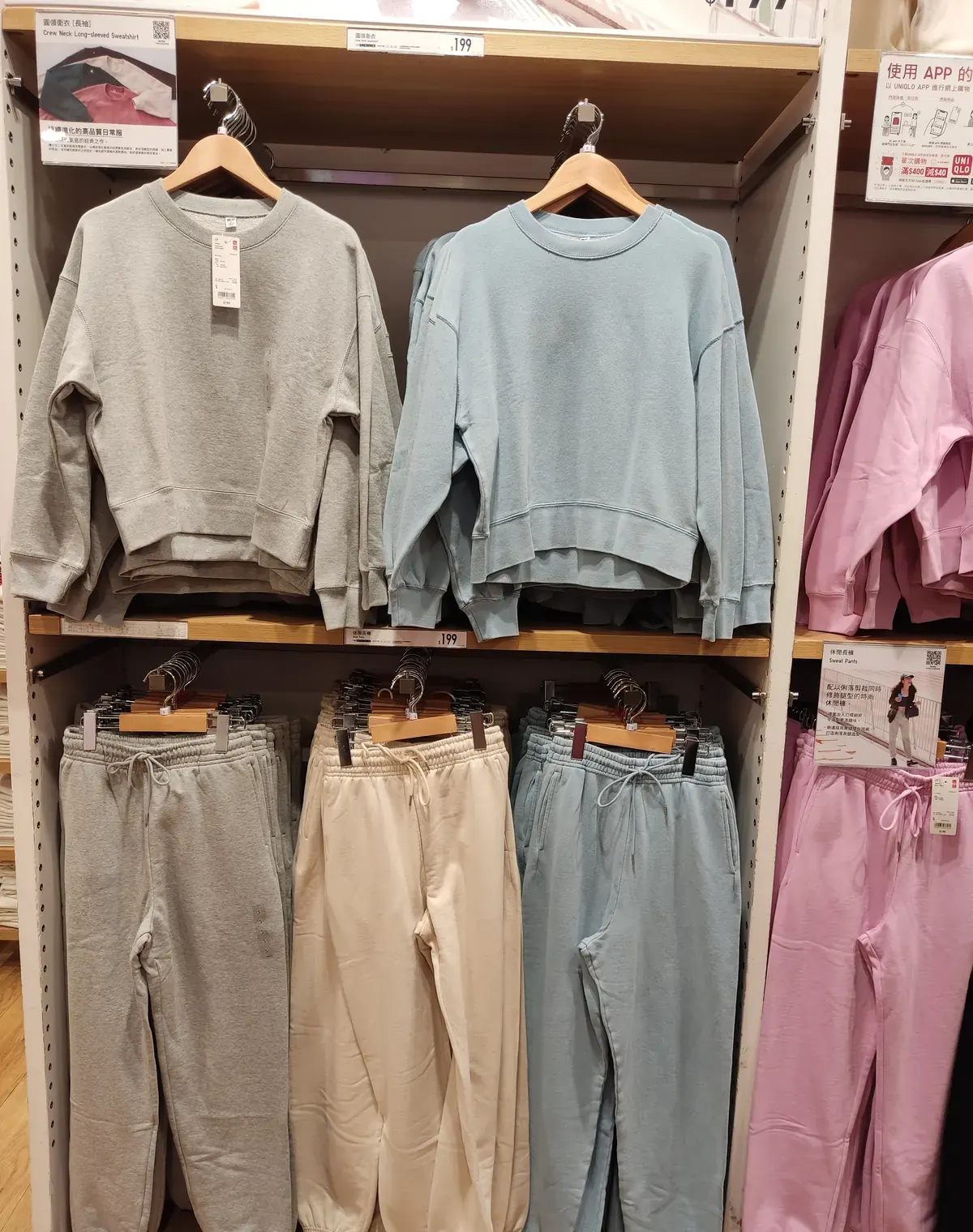
Which women's loungewear pieces have the most demand?
Base layers and trousers lead, together about two-thirds of estimated demand for women's loungewear in the homewear catalogue compared, from 3 September to 29 October 2026. We do not rank one above the other, because the two figures are close and their likely ranges overlap heavily. Sets come a distant third.
| Piece | Share of estimated demand |
|---|---|
| Base layers (bodysuits, camis, undershirts) | 33.8% |
| Trousers | 33.0% |
| Sets | 10.6% |
| Tops | 6.9% |
| Shorts | 6.6% |
| Dresses | 5.4% |
| Jumpsuits | 1.9% |
| Leggings | 1.4% |
| Hoodies and sweatshirts | 0.3% |
The surprise for anyone searching for a tracksuit or a hoodie is how small those groups are here. Hoodies and sweatshirts barely register, and tracksuits are a small group. These figures stop in late October, so they do not tell you what happens in the coldest weeks.
Autumn did change the mix around the edges. Winter lines rose from about 15% of estimated loungewear demand in September to about a quarter in October, while women's pyjamas reached about 87% in October. Shorts went from about 9% to about 3%. Loungewear turned to winter far more slowly than pyjamas did, so in our judgment it is mostly a year-round purchase.
Is black and white really the safe choice?
For base layers, yes. For everything else, the numbers do not say so. Black and white took about 40% of estimated demand for women's loungewear in the homewear catalogue compared, from 3 September to 29 October 2026, on about 30% of the colour lines. Adding navy brings that to 54.4%. Black was about 22%, white about 19%, navy about 14% and beige about 9%.
Split by piece, the picture changes.
| Piece | Black and white, share of estimated demand |
|---|---|
| Base layers | 75.8% |
| Tops | 32.2% |
| Sets | 21.0% |
| Trousers | 17.7% |
| Everything except base layers | 23.2% |
On base layers, black and white were about 56% of colour lines and about 76% of estimated demand, so demand runs well ahead of the range. Outside base layers, they were about 21% of lines and about 23% of demand, which is in line with their share of the range. The season matters too. The pair took 62.4% on all-year lines, 33.1% on winter lines and 15.0% on summer lines.
That lead held through the period, at about 40% in both September and October. Rose edged up, from about 4% to about 7%.
So we would buy a bodysuit or cami in black or white without much thought, since it usually sits under something else. We would not carry that logic over to the trousers or set you will actually be seen in.
Which colour should you choose for loungewear trousers?
Choose the one you like, because no colour clearly led. In the homewear catalogue compared, from 3 September to 29 October 2026, five colours each took roughly one in nine to one in six of estimated demand for women's loungewear trousers, and their likely ranges overlap.
| Trouser colour | Share of estimated demand |
|---|---|
| Beige | 16.6% |
| Black | 15.0% |
| Navy | 14.9% |
| Blue | 12.6% |
| Rose | 11.1% |
The order is not worth relying on. One product alone was about half of beige and about half of navy, so one popular pair can lift a whole colour.
If you searched for melton trousers, we have no figure for you. Too few lines clearly named the fabric for a share to stand. We would ask the seller for the fabric and weight rather than trust a label on a photo.
What size of women's loungewear should you look for?
Go by the piece, not by one curve for the whole category. In the homewear catalogue compared, from 3 September to 29 October 2026, trousers ran from M through 3XL, sets gathered in L and XL, and base layers kept more of their demand in S.
| Size | All loungewear | Trousers | Sets | Base layers |
|---|---|---|---|---|
| S | 12.0% | 7.3% | 5.0% | 16.5% |
| M | 23.5% | 25.0% | 19.5% | 23.2% |
| L | 20.0% | 19.7% | 26.6% | 19.4% |
| XL | 20.5% | 19.2% | 26.9% | 17.6% |
| 2XL | 15.9% | 16.1% | 19.4% | 20.3% |
| 3XL | 7.7% | 12.7% | 2.6% | 3.0% |
Part of this reflects which sizes were on offer, so a low 3XL figure is not proof that few women wanted it. Loungewear looks smaller than pyjamas at first, with 3XL at 7.7% against 13.0%. On lines offered from M to 3XL, though, 3XL was about 17% in loungewear and about 16% in pyjamas. The difference is mainly the range, not the women buying.
Labels vary between brands, so these shares say what was chosen, not what fits you. We would check measurements before ordering, especially on fitted base layers.
How much should women's loungewear cost?
About half of estimated demand for women's loungewear was under EGP 500 and about 85% under EGP 750, in the homewear catalogue compared, from 3 September to 29 October 2026. The middle half sat at about EGP 300 to 600. The piece sets the price far more clearly than the colour does, because each piece sits largely in a single band.
| Piece | Where demand sits | Typical price |
|---|---|---|
| Tops | Nearly all under EGP 500 | About EGP 250 |
| Base layers | Nearly all under EGP 500 | About EGP 300 |
| Dresses | Mostly EGP 500 to 750 | About EGP 500 |
| Trousers | Mostly EGP 500 to 750 | About EGP 600 |
| Sets | Nearly all EGP 1,000 or more | About EGP 1,550 |
Across the whole category, 51.5% of estimated demand was under EGP 500, 33.9% at EGP 500 to 750, 4.4% at EGP 750 to 1,000 and 10.2% at EGP 1,000 or more. Very little demand sat between trousers and sets. With a typical set at about EGP 1,550, a typical pair of trousers at about EGP 600 and a typical top at about EGP 250, we would price both ways before choosing a set. For wider fashion price bands, see our report on fashion pricing in Egypt.
Colours can mislead here. White looks cheap and burgundy looks dear mainly because of the pieces they appear on, not because of the shade.
Why is it hard to find white, or a 3XL?
Both were short in late October 2026. In the homewear catalogue compared, about two-thirds of white sizes on women's loungewear were available against about 85% of black, and about 65% of 3XL sizes against about 89% of S.
| Available, late October | Share of sizes |
|---|---|
| S | 88.9% |
| M | 81.8% |
| L | 71.3% |
| XL | 69.3% |
| 2XL | 67.4% |
| 3XL | 64.9% |
Neighbouring sizes are too close to separate, but the slope from S to 3XL is clear, and that gap was the same in early September: 89.8% against 65.0%. So this looks like how the range is run, not a late-season shortage.
Offering a size is not the same as having it. About half of lines were offered with a 3XL, but only about a third had one available. By piece, the share of lines with a 3XL available at some point in the period was 17.6% for base layers, 21.0% for tops, 42.4% for sets and under half for trousers.
White is the odd one out among colours. The gap with black appears within each piece, so it is not a matter of which garments come in white. On tops, 38.8% of white sizes were available against 91.7% of black. On trousers it was 33.3% against 77.6%, and on base layers 76.5% against 100%. White and black are close in estimated demand, yet this does not show that white runs out faster. It may simply be supplied more thinly.
Complete size runs were the exception on summer lines. In late October, 30.8% of summer lines had every size available, against 60.3% of all-year lines and 59.8% of winter lines. On summer lines, 40.0% of 3XL sizes were available against 87.9% of S. If you want a white basic or a 3XL, we would buy it when you see it, and treat a late summer line as a bonus.
What should women's loungewear brand owners take from this?
These are questions for your own range, not a buying formula. Your own orders should decide.
- Plan two colour stories. Black and white were 75.8% of base-layer demand and 17.7% of trouser demand in that catalogue. An account-wide colour rule would misjudge both.
- Keep white available. White was about 19% of estimated demand, with about two-thirds of its sizes available in late October. In our judgment it is the clearest gap to check first in your own numbers.
- Check the lines that carry you. Nearly all of the 30 lines with the most estimated demand had a full size run available in late October. That is partly circular, since a line missing sizes is less likely to reach that list, so do not take it as proof of safety. Our guide to ads on unavailable products covers what to do when sizes run short.
- Offer a 3XL you can honour. About half of lines were offered with one and about a third had one available. On lines offered from M to 3XL it was about 17% of demand, close to pyjamas.
- Sell the piece, not the category. Base layers and trousers have different colours, sizes and prices. In our judgment they deserve separate ad sets and separate creative.
If you sell women's loungewear and want a second opinion on your range and ads, message Mojo on WhatsApp and we will start with what we would fix first.